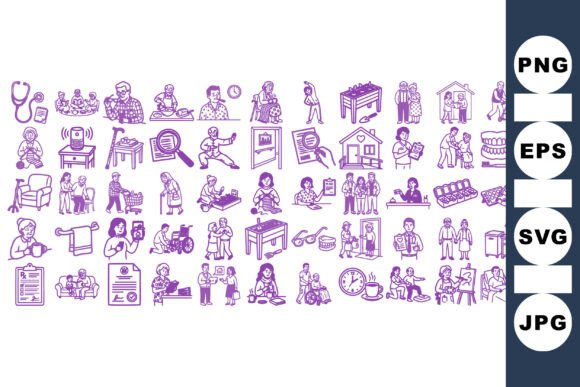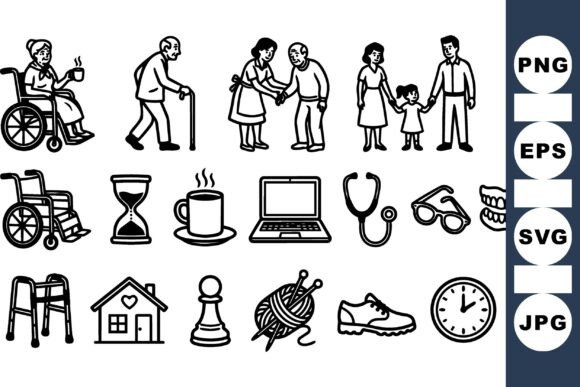
Elderly Care Hand Drawn Icons
A Quiet Kindness, Stitched Right
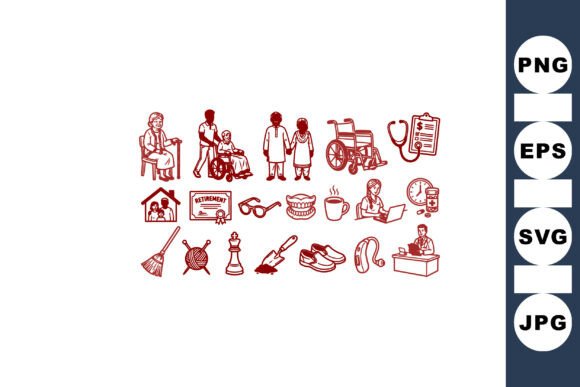
When I opened the Elderly Care Hand Drawn Icons ZIP file, what struck me first wasn’t technical precision—it was tone. These aren’t clinical or sterile medical icons. They’re soft-edged, slightly uneven line drawings: a hand holding another hand, a steaming mug beside a folded blanket, a stethoscope resting gently across an open book. There’s breathing room in the lines. No sharp angles, no aggressive contrast—just compassionate clarity. As an embroidery designer who’s stitched everything from neon festival patches to hospital staff apparel, I immediately pictured this set on a linen tea towel for a senior wellness fair, or as a subtle chest embroidery on a cotton apron for a dementia-friendly day program.
Where It Lives Best—And Where It Breathes
Elderly Care Hand Drawn Icons shines brightest on medium-weight, stable fabrics where line integrity matters more than flash: organic cotton tote bags, unbleached canvas patches, midweight sweatshirt fronts, and pillow covers meant for quiet spaces. I recently mocked up one of the “gentle hands” icons (about 3.2” wide) on a cream-colored baby blanket—intended as a gift for a new caregiver—and the simplicity translated beautifully into stitch. The running stitch outline held its shape without crowding; the negative space between lines stayed legible even at that scale. That’s rare in line art meant for embroidery. It also works well for small-batch applique designs: cut the shape from soft fleece, then stitch around the edge with a satin stitch border—no dense fill needed.
This set feels purpose-built for handmade product makers who value emotional resonance over trend-chasing. Think Etsy sellers offering personalized gifts for nurses, hospice volunteers, or adult children coordinating elder care. A single icon stitched onto a folded kitchen towel says “I see your work” without words. On a navy cap for a home health agency? It reads as grounded, not generic.
Where to Pause—and Test First
Don’t assume it’ll translate cleanly everywhere. Because these are hand-drawn line icons—not vector-optimized embroidery files—the fine details demand attention before committing thread and time. On stretchy fabric like jersey knit or thin ribbed cotton, those delicate loops and tapered ends can distort under tension. I tested one of the “pill bottle” icons on a lightweight t-shirt mockup and saw minor blurring in the cap’s curve—fixable with tear-away stabilizer + light spray adhesive, but worth checking.
Hoop size matters here too. Most icons sit comfortably in a 4×4 hoop, but some—like the “wheelchair + tree” scene—push close to 5”. If you’re stitching on curved surfaces (caps, curved apron pockets), test placement early. The gentle line weight doesn’t carry well below 2” tall; tiny corners lose definition, and narrow stems (like the handle of the “walking cane” icon) risk vanishing in dense stitch areas or on textured toweling.
Dark fabric is kinder to this set than light—if you’re using black thread on charcoal linen, the line weight reads with warmth and intention. But on white cotton with pale grey thread? Some icons fade visually unless you add a subtle underlay or increase stitch density just enough to anchor the line. Always run a black-and-white mockup first. What reads as tender on screen can read as faint on cloth.
Practical Notes Every Embroidery Designer Should Keep Handy
- Test on scrap fabric first—especially if stitching on blends, bamboo, or brushed cotton. Line art relies on edge contrast, and fabric nap eats subtlety.
- Review stitch density before digitizing. These icons were delivered as SVG/EPS/JPG/PNG—not native embroidery files—so you’ll need to convert them. Avoid over-digitizing delicate curves; let the hand-drawn quality breathe.
- Confirm hoop compatibility early. One icon stretches width-wise; know whether your machine’s max hoop fits it comfortably—or if you’ll need to resize thoughtfully.
- Inspect small details at actual stitch scale. Zoom in on your embroidery software: do the “eyeglasses” icon’s arms taper cleanly? Does the “heart + house” symbol hold separation between shapes? If not, a light manual cleanup saves re-hooping later.
- Use proper stabilizer—cutaway for knits, tear-away for stable wovens. These icons rely on clean line starts/stops; puckering ruins their quiet authority.
- Check licensing before selling finished products. The product description confirms it’s for healthcare brochures and community resources—but verify commercial use rights if you’re listing embroidered patches or custom apparel on Etsy or at craft fairs.
What It Adds to Your Finished Product—Beyond Aesthetics
Elderly Care Hand Drawn Icons quietly elevates perceived value. Not through complexity, but through intentionality. Customers notice when a design feels *made for the moment*, not just placed on it. A boutique selling handmade nursing gifts told me her customers specifically asked for “something that doesn’t look like a stock medical clipart”—and this set answered that. It supports brand consistency for small shops focused on empathy-led messaging: gentle color palettes, natural fibers, unhurried presentation. And because it avoids cliché (no cartoonish hearts or oversimplified caduceus symbols), it earns trust—especially from healthcare workers and caregivers who’ve seen too many shallow visual tropes.
It also performs well in digital contexts: printable mockups for client approvals, social media previews for holiday embroidery collections, or digital embroidery file listings where buyers want to visualize real-world use before purchasing. As a graphics asset, it bridges crafts and thoughtful communication—ideal for creatives building a cohesive suite of design assets across print, embroidery, and web.
Final Thought: A Design That Listens
Elderly Care Hand Drawn Icons isn’t flashy. It won’t dominate a trade show booth. But in the right context—a stitched tag on a handmade memory box, a subtle chest logo on a volunteer’s apron, a quiet embroidery on a caregiver’s holiday card—it lands with weight and warmth. For embroidery designers, craft business owners, and Etsy sellers who believe tools should serve people first, this set delivers exactly what it promises: compassion, drawn by hand—and ready to be stitched with care.